Coast to Coast

Planning a Coast to Coast walk

Planning your Walk

Planning a Coast to Coast walk requires thoughtful preparation. The full route covers 192 miles and crosses some of the most rugged and remote landscapes in England. Walkers should be ready for fast-changing weather, low visibility, boggy moorland, rocky ground, and sustained climbs and descents over mountainous terrain. At a minimum, you’ll need both digital and paper maps, a compass, a torch or headlamp, and reliable waterproof clothing.

Although the Coast to Coast path attracts over 10,000 walkers each year, this should not lull you into thinking it’s easy. Some sections are physically demanding — especially in poor weather — and good preparation will make your experience safer and more enjoyable.
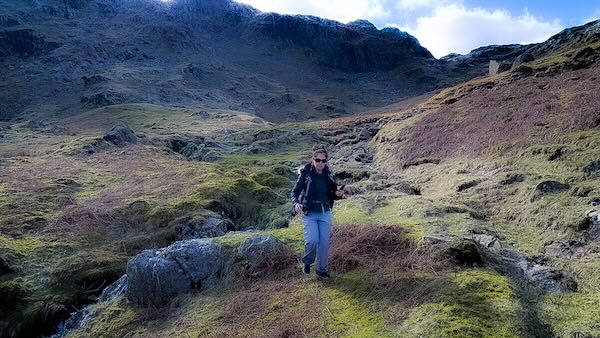
Carol descending into Far Easedale from Greenup Edge

Rugged Terrain on the back wall of Far Easedale

If you can, consider a few weekend practice hikes to test gear and build confidence. Birkdale Common, between Kirkby Stephen and Keld, is a good example of how exposed and challenging some stretches can be in mist or rain.

With careful navigation and realistic daily planning, the path is manageable. But weather in the uplands can change quickly, and even well-trodden tracks can become hard to follow. Carrying a physical map and knowing how to use it is strongly advised.
The trail traverses three national parks, each with its own character:

The Lake District is mountainous, dramatic, and often wet underfoot.
The Yorkshire Dales offer rolling hills and limestone pavements typical of a karst landscape.
The North York Moors provide open heather moorland, punctuated by steep valleys and areas of deep bog.

Lastly, always tell someone your intended route and expected arrival time, especially if walking solo. Mobile signal is not reliable in remote areas.

What to Take on the Coast to Coast

Even if you’re planning to stay in accommodation each night, the Coast to Coast crosses wild, remote country where weather and conditions can change fast. Pack for safety, comfort, and resilience.

Essential Gear:
1. Digital map on your phone (e.g. OS Maps or Google Maps)
2.
Paper OS map (large scale, in waterproof cover) as backup
3.
Guidebook – digital if possible, ideally stored on your phone
4.
Compass – and know how to use it
5.
Waterproof rucksack or rain cover
6.
Waterproof jacket and trousers, even in good weather
7.
Spare warm layer – fleece or insulated jacket
8.
Extra food and plenty of water
9.
Survival whistle – learn the emergency signal: three loud blasts, each three seconds long, with three seconds between
10.
Durable footwear – suited for deep mud, sharp rock, and long mileage
11.
Torch or headlamp, with spare batteries (and bulb if applicable)
12.
Basic first aid kit
13.
Survival bag or emergency bivvy

Being well-prepared makes the walk not just safer, but far more enjoyable — especially when weather or visibility deteriorates.

Birkdale Common

Prepare for Mist & Mire


Birkdale Common is a sodden moorland plateau, infamous for deep bogs and shifting mist. Whichever route you follow, expect wet feet. Sturdy boots, spare socks, and waterproof layers aren’t just wise — they’re essential.

Descending White Hill

Prepare for long, steep descents


Typical of the North York Moors are long, stepped descents like this one on White Hill — often followed by another climb and another descent. The repetition can be taxing on the knees, so prepare accordingly with poles, pacing, and joint support if needed.

Hiking the Coast to Coast trail guide

Hiking the Coast to Coast is a digitally enhanced eBook designed to accompany you on your journey along the Coast to Coast path. Available on Apple Books for iPhone, iPad and Mac, the guide includes:
• Mapping with interactive features
• Step-by-step route directions
• Hundreds of colour photographs
• Route conditions in different weather
• Historical and cultural points of interest

Whether you’re planning your trip or already on the trail, it’s a practical and beautifully illustrated resource to carry with you.

Quick Snippets

How Long Does Walking the Coast to Coast UK path Take?

Most people walk the Coast to Coast path in 16 days. Guide books divide the walk into 16 different sections, each ending at convenient places to stop overnight. Each day's walking may vary from 7 miles (the smallest) to 15 miles (the longest). The majority of walkers follow these guidelines. You should also allow 1 day for travelling to St Bees where it all starts, and 1 day for travelling home from Robin Hood's Bay, where it finishes.

Is the Coast to Coast walk a difficult walk?

The Coast to Coast walk is not a path in its own right, (it is currently undergoing a Ministerial upgrade to a National Trail, to be completed by 2023) but rather a path made up from adding sections of other paths together, so as to produce a reasonably challenging and thoroughly enjoyable walk in the most pleasant scenery possible across the breadth of England. It was devised by Alfred Wainwright for this specific purpose. Some sections of the walk are challenging but reasonably fit people should find no problem with them. Navigation can be tricky in poor weather but you can prepare for this with guide books, maps and a compass.

How Can I Prepare to Walk the Coast to Coast Path?

Almost certainly your walk will entail at least one or two days walking in inclement weather. You should assume that every day could be inclement and ensure that you always carry warm and waterproof clothing with you, together with a waterproof rucksack to carry spare clothing in. Ensure you have all the right equipment, that you always let someone know where you will be walking each day, and what time you expect to return. Plan ahead by booking your overnight stays, whether camping or hoteling. Take plenty of water with you to drink and nourishing, energising food. Make sure you are fit and that you have read the map and guide book for each day's walk.

What Emergency Equipment should I carry on the Coast to Coast walk?

Emergency equipment is similar for most walks in England. You should always carry and know how to use the following: A good whistle (and a spare), a medical kit, spare clothing in a waterproof wrapping, waterproofs, adequate footwear, plenty of water, and high energy food, a compass (you can't always rely on a smartphone as the battery may fail in cold or wet weather), a digital book guide, a backup paper map in a waterproof wallet, a torch, spare batteries and a spare bulb, a survival bag.
Steep and extended stone steps descending White Hill near Ennerdale, a taxing section of the Coast to Coast path requiring care and knee support Boggy terrain across Birkdale Common on the Coast to Coast route, highlighting the need for waterproof boots and careful footwork