Rottington Beck, St Bees - Coast to Coast
More Articles in the St Bees to Ennerdale Bridge subsection
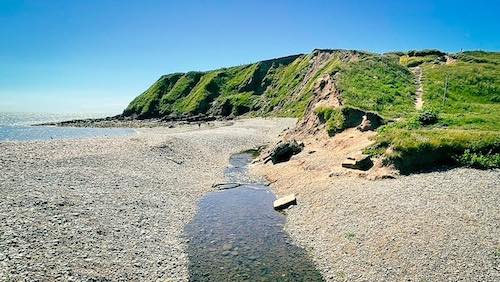
Rottington Beck near to South Head
Rottington Beck, St Bees, Coast to Coast
Rottington Beck has two distinct sources: one rises from a spring in a small field on Hannah Moor, west of Sandwith; the other from a series of springs feeding a pond just north of Townhead. These merge at Sandwith Newtown, after which the beck is joined by a woodland tributary flowing from Rottington Woods. Continuing south into the hamlet of Rottington, it gains further strength from the Thorney Beck, which originates at Demesne Farm. From there, the beck turns southwest, descending to the South Head of St Bees coastal headland. At its mouth, a long wooden bridge spans the beck where it meets the beach — the crossing point for Coast to Coast walkers setting out on the first leg of their journey.
Rottington Beck at Gutter Foot
Just before reaching the Irish Sea, Rottington Beck slips quietly through its narrow channel beside South Head. Crossing the modest footbridge, Coast to Coast walkers step over one of the route’s hidden waterways before watching the beck lose itself amongst the shifting sands and incoming tides.
Gutter Foot Bridge
Crossing this simple wooden footbridge, Coast to Coast walkers leave the beach behind and begin the first climb towards St Bees Head. Beneath their feet, Rottington Beck disappears into its flood channel before continuing across the sands to the Irish Sea, a reminder that even this modest stream has shaped the landscape and prompted careful flood protection.
Rottington Beck Christy Meadows
Leaving the roadside behind, Rottington Beck begins to wander freely through the quiet meadows of Christy Meadows. Fed by the waters of Thorney Beck, it meanders gently between pasture and hedgerows, where the only sounds are birdsong and the soft murmur of flowing water before its final journey to the Irish Sea.
Rottington Beck Rottington Hall
Flowing quietly through the meadows near Rottington Hall, the beck winds between grazing pasture and flowering hedgerows in one of the valley’s most peaceful corners. The nearby hamlet, with origins stretching back centuries, hints at a long farming tradition, while a small tributary quietly joins the beck before it continues towards Christy Meadow Bridge and the Irish Sea.
Rottington Wood Tributary
Hidden beneath the leafy canopy, this tiny woodland stream marks the beginning of one of Rottington Beck’s quietest tributaries. A faint footpath threads its way through the trees, where the gentle trickle of water, birdsong and dappled shade create a secluded corner that few Coast to Coast walkers ever discover.
Sandwith Newtown
Threading quietly through Sandwith Newtown, Rottington Beck follows the narrow lane in a shallow stone-lined channel, almost hidden beneath overhanging walls and hedgerows. The gentle curve of the road, old farm buildings and the soft sound of running water create a timeless rural scene that has changed little over generations.
Take the Coast to Coast Guide With You
Available on Apple Books — £12.99
Hiking the Coast to Coast combines step-by-step route directions, interactive mapping, hundreds of original photographs and information about the landscapes, history and places encountered along the route.
© 2026 Roy McKee · Coast to Coast
Contact - Privacy. - Terms


