Gamelands Stone Circle, Raisbeck
More Articles in the Orton to Kirkby Stephen subsection
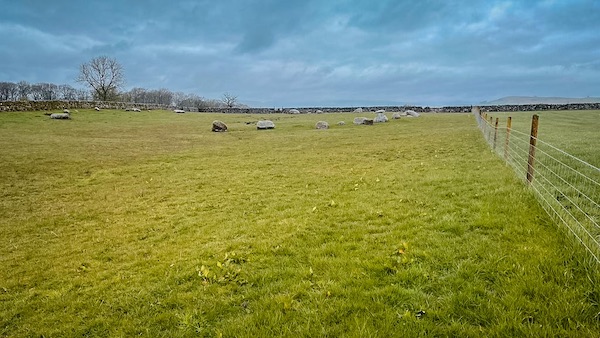
Gamelands Stone Circle, Knott lane in Raisbeck
Gamelands Stone Circle, Raisebeck, Coast to Coast
Gamelands Stone Circle lies about 200 yards north-west of the hamlet of Raisbeck and approximately 1 mile east of Orton. Dating from the Late Neolithic or Early Bronze Age, it is one of Cumbria’s largest stone circles. Although only 42 stones remain today, the monument originally comprised many more. The circle forms a broad oval about 100 yards in circumference, with none of the surviving stones standing more than a metre high. Archaeological discoveries made at the foot of nearby Knott Scar, around 100 yards to the north, indicate prehistoric activity in the area dating from approximately 1800–1400 BC.
Beyond the stone circle rises Great Asby Scar, crowned by the 412-metre summit of Knott and forming one of England’s finest limestone pavements. The scar extends westwards into Orton Scar, creating an extensive limestone landscape. The stone circle is reached by turning into Knott Lane from the B6261 or, for Coast to Coast walkers, by turning right where the route crosses Knott Lane below Knott Scar.
Gamelands Stone Circle
Spread across the pasture beneath Knott Scar, Gamelands is easy at first to underestimate. Most of its surviving stones lie low in the grass, but as the eye follows them around the field the great oval gradually emerges — one of Cumbria’s largest prehistoric stone circles. Beyond, the pale limestone uplands of Great Asby Scar rise above the monument, giving this quiet gathering of ancient stones a remarkable sense of place and permanence.
Raisbeck (Gamelands) Stone Circle
The circle becomes harder to read when viewed among its individual stones. Historic England records about 40 surviving blocks, most of pink granite, now lying low or recumbent in the pasture, with a single limestone boulder among them. Walk around the field, however, and isolated stones begin to connect: fragments of an immense prehistoric oval slowly re-form in the eye, giving a tantalising impression of the monument that once stood here.
Knott Lane
Knott Lane passes within a few metres of Gamelands, so the great prehistoric circle can be reached with only a short diversion from the Coast to Coast. A gate stile opens directly into the field, where the stones lie beneath the rising limestone of Knott Scar. There is little ceremony to the approach — and perhaps that is part of its appeal. One moment you are following a quiet country lane; the next you are standing within a monument laid out thousands of years ago.
🏛️ Insight - Archaeology
Gamelands Neolithic Stone Circle
Why Were Stone Circles Built?
Unlike prehistoric settlements, stone circles were not places where people lived. Archaeologists generally regard them as ceremonial monuments, built during the Late Neolithic and Early Bronze Age as places where communities gathered for rituals, seasonal celebrations and the remembrance of the dead. Although their exact purpose remains uncertain, excavations have revealed cremation burials, pottery and worked flints at many sites, suggesting that different circles fulfilled different ceremonial roles over many centuries.
The position of many stone circles appears to have been carefully chosen. They often occupy gentle ridges or natural terraces overlooking rivers, valleys or prominent hills, where the surrounding landscape formed part of the monument itself. Some also align with the rising or setting sun at significant times of the year, although not every circle was constructed with astronomical precision. At Gamelands, the relationship between the River Lune, Knott Scar and the limestone uplands of Great Asby Scar creates a striking natural setting that may have influenced the choice of location.
Hiking the Coast to Coast trail guide
Hiking the Coast to Coast is a digitally enhanced eBook designed to accompany you on your journey along the Coast to Coast path. Available on Apple Books for iPhone, iPad and Mac, the guide includes:
• Mapping with interactive features
• Step-by-step route directions
• Hundreds of colour photographs
• Route conditions in different weather
• Historical and cultural points of interest
Whether you’re planning your trip or already on the trail, it’s a practical and beautifully illustrated resource to carry with you.


