Jenny Bradley Cross, Bloworth Crossing
More Articles in the Clay Bank to Lion Inn subsection
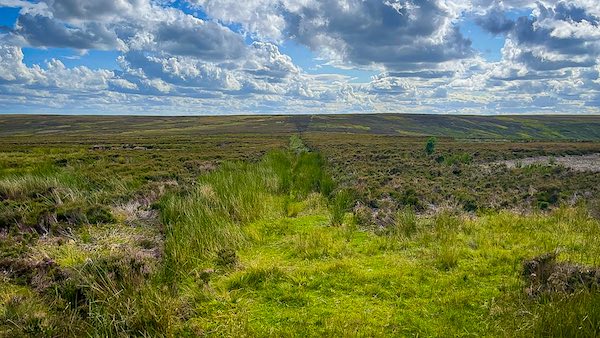
Looking west from Jenny Bradley Cross over Greenhow Moor
Jenny Bradlley Cross, Greenhow Moor, Coast to Coast
The Jenny Bradley Cross is an ancient wayside cross located on Greenhow Moor on the old packhorse way close to Bloworth Crossing. The old packhorse way is paralleled by the disused railway that once ran between Kildale and Rosedale. The Cross is accompanied by a taller Faversham Estate boundary stone. The cross has its head and part of its shaft missing. Crosses and boundary stones are numerous in this area.
The Jenny Bradley Cross is only 200m north of Bloworth Crossing. The disused railway has been superseded by the Cleveland Way, which runs east along Urra Moor and Greenhow Moor to Bloworth Crossing. The Coast to Coast route also travels east along the Cleveland Way. The two routes separate at Bloworth, the Cleveland Way turning north and the Coast to Coast continuing east.
Jenny Bradley Cross
The Jenny Bradley Cross is the smaller of the two stones. The larger stone is a Boundary Stone. It has the name of Sir W Fowels etched upon its north face. Wayside crosses are types of Christian crosses dating between the 9th and 15 centuries AD. The Jenny Bradley Cross is such a cross. Such crosses were multi-functional in that they reminded walkers of the Christian faith, they were way markers, they were pathway guides in adverse weather and terrain, and they reassured walkers they were not lost.
Jenny Bradley Cross
The north face of the Boundary Stone has etched on it a large F with the date of 1888 below. The Cross to the side of the Boundary Stone is ancient and its head has broken off. It is a scheduled monument with Historic England. The F denotes the Earldom of Feversham's land. Sir W Fowels is believed to be Sir William Foulis of Ingleby, 8th Baronet.
Cross and Stone
The ancient (9th to 15th centuries) Jenny Bradley Cross and more modern 19th century Boundary Stone line up with each other when looking at their east side, so that the Cockayne Ridge of Bransdale Moor is seen in the background. The Jenny Bradley Cross is thought to be the sister stone of the Margery Bradley Cross near Flat Howe, a little north of the Lion Inn.
Close up of Name
Sir W Fowels is the name of the 8th Baronet, Sir William Foulis of Ingleby.
Way Markers
In isolated, bleak or mountainous areas, in the ancient past when vehicular traffic did not exist, many folk would become lost or unsure if they were still following the correct route. To vanquish this quandary individuals began to build up loose heaps of stones (cairns). The Romans eventually began replacing them with fixed, erect stones at regular intervals.
Way Markers often served a dual purpose, e.g. some where also used as boundary stones, often with the initials of the estate owner etched into it.
Milestones would give the distance to a town, often with a pointer such as an arrow or even a hand indicating the direction.
In 1697 William III passed legislation requiring surveyors to erect guide stones at crossroads in remote areas, indicating the way to the nearest market town
In the 17th century Royal Mail began to erect milestones in order to help their post riders to find their way and make good time, measuring their progress by the mileage remaining.
Coast to Coast Trail Guide
Hiking the Coast to Coast
"Hiking the Coast to Coast" is a digitally enhanced eBook available from Apple Books for all people who have either a Mac, an iPhone or an iPad, and is designed to accompany you on your walk of the Coast to Coast path. The trail guide contains Ordnance Survey maps and other advanced mapping features, step by step directions, hundreds of colour photographs, details of the route, its conditions in different weather and research snippets relating to places of interest along the way.
